
Bend Smarter, Not Harder: Protecting Your Back in Cheer, Dance, and Gymnastics
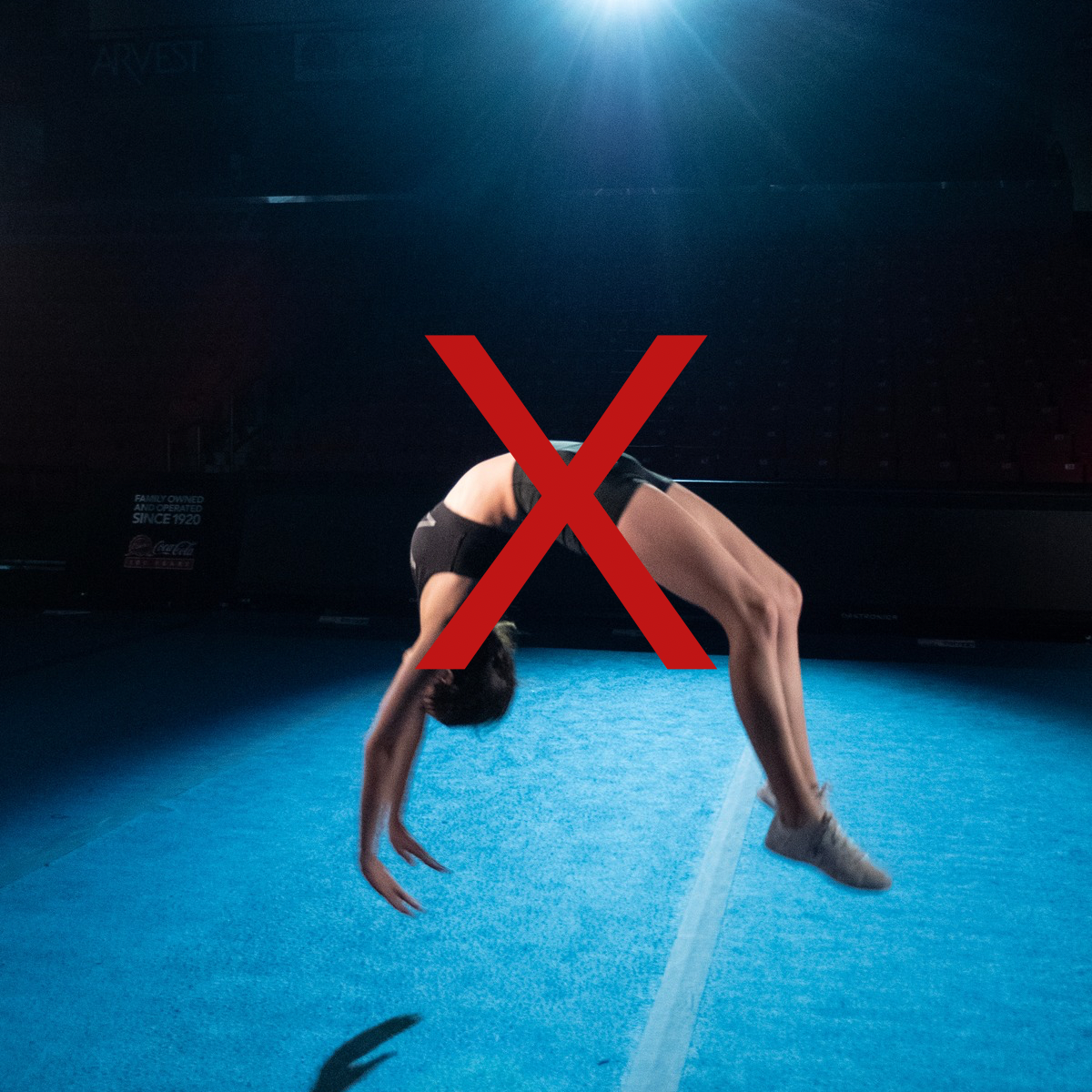
Whether it’s a gymnast pressing into a bridge, a dancer lifting into an arabesque, or a cheer flyer pulling a scale or needle, one thing is clear: extension skills are beautiful—but repeated end-range back extension isn’t ideal for long-term spine health. Because these skills are a part of the sports we love, the goal isn’t always to avoid them—it’s to perform them efficiently by sharing the movement between the hips, lumbar spine, and thoracic spine. Stay around CheerX long enough and you will learn about the 3 most common body blocks of dysfunction. Today you will learn about one consideration of one of the blocks: the hips. Specifically, hip extension.
Hip Extension: Doing Its Share
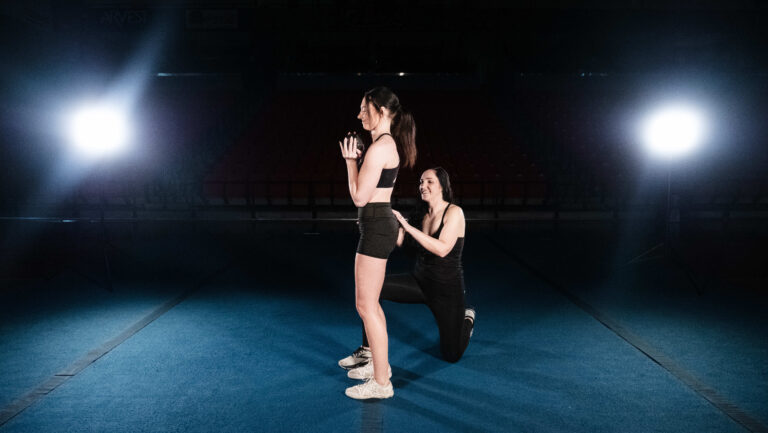
Hip extension means opening the front of your hip, like moving your leg back behind you. The normal range of hip extension is about 10–30°. Everyday life only requires about 10–15°, but athletes in gymnastics, dance, and cheerleading should consistently be at the upper end of normal (20–30°). When the hips provide their share of motion, the low back and mid-back don’t have to take on extra stress.
Lumbar Lordosis: The Low-Back Curve
The lumbar spine naturally curves inward—this is called lordosis. That curve should move a little more during extension skills, but only its share. If the hips are stiff or weak, the lumbar spine ends up arching too much, doing extra work it wasn’t designed to handle alone. This also frequently leads to excessive anterior pelvic tilt which comes with it’s own set of issues.
Mid-Back (Thoracic Spine) and Shoulder Mobility: The Forgotten Players
The mid-back (and shoulder mobility) is often overlooked, but it plays a big role in distributing low back extension forces. Without it, athletes rely on a single “hinge point” in the low back. Teaching athletes to move through the thoracic spine helps distribute the load more evenly.
Side-Bending and Rotation: Built-In Helpers
Though sagittal plane movements (lumbar flexion/extension) are often the focus, it is equally important to think about the body 3 dimensionally and consider movements in the coronal/frontal plane (side bend) and transverse plane (rotation/torsion).
Asymmetrical extension moves like arabesques, scales, and needles don’t just involve bending backward. The low back will also lean to the side (side-bend) and twist (rotate) to compensate for lack of proper mobility through the hips, or when it has met the normal end range . This is normal to a degree—but if hips aren’t contributing, those side and twist motions become exaggerated, stressing the spine.
Need to get the leg higher pulling into a scale or needle? Your body MUST get the motion from somewhere else as it is impossible to accomplish this only through the hip. However research has shown that the less hip extension available, the more your body will compensate into sidebend and rotation, even when doing a simple backbend. And the result? Increased risk of pain or injury to the spine.
Why It Matters
- Gymnastics : Bridges, back walkovers, and extension tumbling skills like back handsprings should be a team effort between hips, low back, and mid-back (just to name a few…).
- Dance: Arabesques and penchés look their best when the spine and hips contribute equally.
- Cheerleaders: Tumblers have the same considerations as gymnasts. Flyers hitting scorpions, bows, scales, and needles need their stance hip, flying hip, and spine to all share the work.
Why Start Young
Athletes often learn these positions as children. If they learn to rely mostly on their low back early, that habit sticks. Teaching teamwork between hips, low back, and mid-back from the start builds safe patterns that last at every level.
How to Bend Without Breaking
- Stretch the hip flexors (correctly and according to your spine type-hint: this can change over time).
- Strengthen the glutes (so the hips pull their weight).
- Train core control (with posture stacking according to your spine type).
- Mobilize the mid-back if you have a kyphosis (keeping shoulder mobility and presence of scoliosis in mind).
- Shoulder mobility, shoulder mobility, shoulder mobility…
- Watch for warning signs (watch for excessive rib flare, sharp pivot point in the back, or early side bend and rotation through the lumbar spine—signs the back is overworking).
- Form, form, form….keep reading.
Spondylolisthesis: A Hidden Risk in Extension Sports
One of the biggest risks for athletes who perform repeated backbends, arabesques, and hyperextension skills is spondylolisthesis—a condition where one vertebra slips forward on another, usually in the lower back.
This forward slip often begins with a small stress fracture in the pars interarticularis (the thin bone bridge at the back of the vertebra) caused by repetitive hyperextension. Gymnasts, cheerleaders, and dancers are among the athletes most at risk because their sports demand constant backbending and overhead leg positions.
Spondylolisthesis is one of the leading causes of back pain in young extension athletes, right alongside myofascial responses and movement compensations
The key is early recognition and prevention: building strength in the hips and core, stretching smart, and avoiding “hinging” through one spot in the low back, and addressing global restrictions and deficits all reduce the repetitive stress that sets athletes up for this condition.
Technique Matters: Protecting Your Spine During Back Handsprings and Bridges
One of the biggest myths in cheer and gymnastics is that you need a super flexible back to do a back handspring. In reality, a well-executed back handspring relies far more on shoulder mobility and proper technique than excessive back bending. Technique isn’t just about making the skill look good—it’s also about protecting the spine. That’s why coaches encourage athletes to “elongate” their back handsprings. A longer, more stretched-out body position not only creates cleaner technique, but also helps spread the movement through the shoulders, mid-back, low back, and hips instead of placing most of the stress on the low back.
The same principle applies to bridges. A traditional bridge with bent knees often relies heavily on the low back and hips to create the movement. Progressing toward a straight-leg bridge (long bridge) shifts more of the movement to the shoulders and mid-back. However, this progression isn’t right for every athlete. It requires good shoulder mobility, enough movement through the mid-back, strength, and body awareness—not just flexibility. In athletes with thoracic scoliosis, simply trying to get more movement through the mid-back without first understanding their unique spinal alignment can lead to compensation and may even contribute to curve progression. This is why understanding your spine before progressing these skills is so important.
Even with proper technique and appropriate progressions, back bends are still one of my least favorite drills. In most cases, the same goals can be achieved through safer, more targeted exercises that better support long-term spine health.
Understanding how your body moves is about more than improving technique—it’s about building movement patterns that protect your spine, improve performance, and help keep you doing the sport you love for years to come.
Takeaway
Safe and powerful hip extension isn’t about keeping the back out of it—it’s about making sure the hips, low back, and mid-back all do their share.
But there’s another layer: most athletes practice skills on one favorite side. When this happens over and over, the body develops repetitive stress patterns—extra arching, side-bending, and twisting in the same direction. Over time, that uneven loading can create imbalances, discomfort, or even injury.
The best solution is to train both sides. It won’t feel as natural, and it won’t be perfectly symmetrical (everyone has a stronger side), but working extension skills in both directions helps spread the stress more evenly across the body. It’s not about perfection—it’s about keeping athletes healthier for longer.
Coaches and instructors should also build in simple screening for hip extension before asking athletes to perform backbends or hyperextension-based skills. Identifying restrictions early helps athletes learn to use their hips, prevents over-reliance on the low back, and reduces the chance of injury.
When the hips, low back, and mid-back share the work, training is balanced side to side, and athletes are screened before loading extension skills, they move better, look cleaner, and reduce risk of injury. And all of the factors can ultimately make a difference on the score sheet.
A Final Note: The Body Works as a Team
While this article highlights the hips as a key player, the whole body contributes: feet, knees, core control, scapulas, and shoulders (and more) all influence extension skills. Think of the body as one big team—every part has a role, and when everyone does their share, the result is strong, balanced, and safe movement.
Though we have focused on hip RESTRICTIONS it is equally important to consider the other end of the spectrum: the clinically hypermobile athlete which presents a whole new level of challenge. Stick around for future posts…you’ll want to learn more about this one!
Expert’s Perspective
My name is Melinda Paulsell—I’m a Schroth-trained scoliosis, postural, and cheerleading specialist, a physical therapist with over 20 years of experience, and a proud cheer mom. I understand the demands of gymnastics, dance, and cheer not only as a clinician, but also as a parent watching my own daughters perform these very skills.
Over the years, I’ve seen firsthand how spinal compensations develop from pre-adolescence through post-adolescence, especially in athletes who repeat extension-based skills. These changes aren’t fully captured in the research, but they’re consistent observations in my clinical practice—observations that have also been discussed and validated in conversations with spine specialists.
That unique combination of professional expertise and personal experience has taught me just how critical it is to factor in posture and spine type when training athletes. This insight ultimately led me to pursue a specialization, so I can bring practical, evidence-based solutions to the cheerleading, gymnastics, and dance communities—supporting injury prevention, long-term health, and improved sports performance.
While there are general principles that benefit everyone, true performance and safety come from recognizing each athlete’s unique spine type, deficits, and movement patterns. By respecting those differences, we not only keep athletes safe but also help them perform at their very best.
Melinda Paulsell, PT
Schroth-trained scoliosis, spine, and injury prevention specialist | Creator of Biofunctional Pattern Integration, STOP THE PROGRESSION, and the CheerX Biofunctional Performance Method
“When you know your spine, you understand your movement. And when you understand your movement—you can own your performance.”
Disclaimer: The information shared through CheerX is intended for educational and informational purposes only and should not be interpreted as medical advice. Always consult with your physician or a qualified healthcare provider before beginning any exercise or training program, especially if you have an existing condition or injury. Participation in CheerX programs and exercises is voluntary and at your own risk. CheerX and Melinda Paulsell, PT, are not responsible for any injury or health condition resulting from use of this information.